


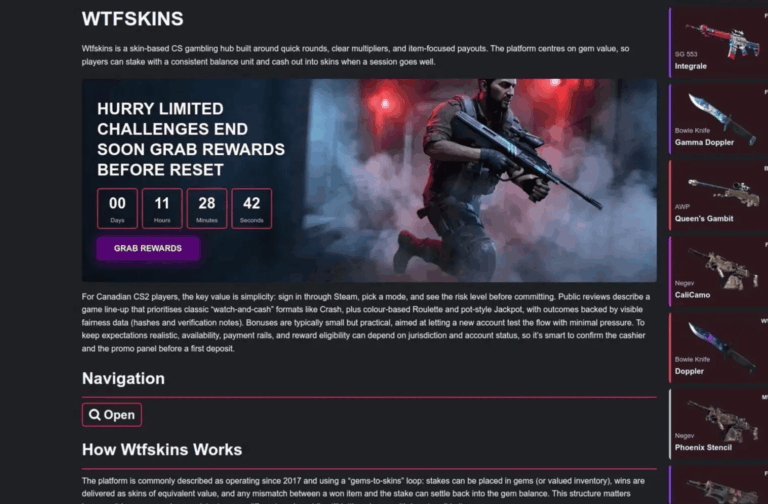
In the world of online CS2 skin gaming, trust is paramount. Players in Canada and beyond need assurance that the outcomes of games are genuinely random and not manipulated by the platform. This is where the concept of a Provably Fair system becomes essential. At its core, a Provably Fair algorithm is a cryptographic method that allows users to independently verify the fairness of each game round. Unlike traditional systems that rely on trusting the platform’s claims, this technology provides a transparent and verifiable process, ensuring that the results were determined before the round began and were not altered. For platforms like cs WtfSkins, implementing such a system is a fundamental commitment to transparency and user confidence.
The system typically operates using three key components: a Server Seed, a Client Seed, and a Nonce. The Server Seed is a secret piece of data generated by the platform’s server. To prevent manipulation, the server provides a hashed (encrypted) version of this seed to the player before the game starts. The Client Seed is a piece of data provided by the player’s browser, which the player can often change. The Nonce is a number that increments with each game round played, ensuring that even with the same Server and Client seeds, each round’s outcome is unique. By combining these elements, a result is generated that neither the player nor the server can controllably predict or alter, creating a transparent gaming environment.
How Wtfskins Implements Its Provably Fair Algorithm
Wtfskins utilizes a standard and robust implementation of the Provably Fair system to ensure the integrity of its game modes. The platform’s approach is rooted in cryptographic hashing, specifically the SHA-256 algorithm. Before a game round begins, the server generates a secret Server Seed. It then hashes this seed and shows the hashed version to the player. This acts as a commitment; the server cannot change the seed after showing the hash, as it would result in a completely different hash value. The player’s browser provides a Client Seed, and the platform tracks the Nonce for each game. When the game round concludes, the platform reveals the original, unhashed Server Seed. With all three components—Server Seed, Client Seed, and Nonce—the player can replicate the calculation and verify that the outcome matches the one displayed.
To help users understand these components, it’s useful to define them clearly. Each element plays a distinct role in the verification chain, and knowing what they are is the first step toward performing a check.
| Term | Description | ||||||
|---|---|---|---|---|---|---|---|
| Server Seed | A secret, random string generated by the Wtfskins server for a series of games. | ||||||
| It is revealed after the rounds are complete. | |||||||
| Hashed Server Seed | The encrypted version of the Server Seed, shown to the player before the game starts to prove it has not been altered. | ||||||
| Client Seed | A random string generated by the user’s browser. | On many platforms, users have the ability to change this seed themselves. | |||||
| Nonce | A number that starts at 1 and increases by one for each game played with the current seed pair, ensuring a unique result for every round. |

A Step-by-Step Guide to Verifying Game Rounds
Verifying a game round on Wtfskins is a straightforward process that empowers you to confirm the platform’s fairness. You do not need advanced technical skills; you just need to know where to find the data and how to use a verification tool. Most platforms, including Wtfskins, provide an interface or instructions to facilitate this process. The goal is to take the data from a completed round and use it to independently recalculate the result. If your calculated result matches the platform’s result, the round is verified as fair.
The process involves collecting the necessary data points from the game you wish to check. This information is typically available in your game history or through a dedicated “Fairness” or “Provably Fair” section on the site. Once you have the data, you can use an independent, third-party SHA-256 hash calculator to perform the verification.
Before you start, make sure you have access to the following pieces of information for the specific round you want to check:
- The unhashed Server Seed for the round.
- The Client Seed used for the round.
- The Nonce (game number) for that specific round.
- The specific formula the platform uses to translate the final hash into a game outcome (e.g., a Crash multiplier or a Roulette number).
Applying Provably Fair Checks to Wtfskins Game Modes
The Provably Fair algorithm is not a one-size-fits-all solution; its application is tailored to the mechanics of each specific game. Wtfskins clearly defines how the cryptographic hash is used to determine the outcome in its primary game modes, ensuring transparency across its offerings.
Verifying Crash Game Outcomes
In the Crash game, the objective is to cash out before the multiplier crashes. The Provably Fair system determines the exact crash point. The Server Seed, Client Seed, and Nonce are combined and hashed. A specific portion of the resulting hash is converted into a number, which is then put through a mathematical formula to generate the final crash multiplier. By following the platform’s published formula, a player can input the seeds and nonce into a verifier and confirm that the calculated crash point matches the one from the game.
Ensuring Fairness in Roulette
For Roulette, the system needs to generate a random number that corresponds to a slot on the wheel (e.g., 0-14). Similar to Crash, the seeds and nonce are hashed using SHA-256. The resulting hash is converted into a number, and a modulo operation (e.g., result % 15) is typically applied to constrain the outcome to the range of possible numbers on the wheel. This ensures the winning number is cryptographically determined and can be verified by anyone with the round data.
| Game Mode | How Fairness is Verified | ||||||||||||
|---|---|---|---|---|---|---|---|---|---|---|---|---|---|
| Crash | The final hash is used in a formula to calculate the exact multiplier where the game crashes. | ||||||||||||
| Roulette | The final hash is converted to a number, and a modulo operator determines the winning slot on the wheel. | ||||||||||||
| Jackpot | The hash determines a “winning ticket” from the total pool of tickets, ensuring a random and fair selection of the winner. |
Provably Fair and Case Opening Integrity
While the article’s theme focuses on what to check before opening a case, it’s important to note that Wtfskins primarily centres on game modes like Crash, Roulette, and Jackpot. The concept of “Case Opening Access” mentioned in some contexts suggests it may function differently than a direct case-opening feature. Regardless of the exact implementation, the principles of Provably Fair verification remain the same. If you encounter a case-opening feature on the platform, you should look for the same transparency signals. A trustworthy system will provide you with the necessary data to verify that the item you received was determined by a fair and random cryptographic process.
Before engaging with any case or game mode, it is good practice to perform a few pre-session checks to ensure you are comfortable with the process.
- Locate the “Fairness” or “Provably Fair” page on the site and read the explanation for how the system works.
- Check if you can view your current Client Seed and if you have the option to change it. This gives you direct input into the outcome’s randomness.
- Review the game history of a few public rounds and see if the unhashed Server Seeds are being revealed as promised.
Common Misconceptions About Provably Fair Systems
Despite its transparency, the Provably Fair concept is sometimes misunderstood. Clearing up these misconceptions is key to appreciating its true value. The most common error is believing that “fair” means “guaranteed to win.” A Provably Fair system does not influence your odds of winning; it only guarantees that the stated odds are respected and the outcome is genuinely random. It ensures a level playing field, but it does not promise profit. Another misconception is that you must verify every single round you play. While you can, the system’s strength lies in the fact that it is verifiable at all. Performing occasional spot-checks is enough to build confidence that the system is operating as described.
| Myth / Fiction | Fact |
|---|---|
| Provably Fair systems guarantee you will win. | |
| They only guarantee that the outcome is random and has not been tampered with. The inherent house edge still exists. | |
| The system is too complex for the average user to check. | With on-site or third-party verifiers, the process is simple: copy and paste the seed data to check the result. |
| If a site says it’s “fair,” you don’t need to check. | The entire purpose of the system is to move from “trusting” to “verifying.” The ability to check is what creates trust. |
Building Trust Beyond the Algorithm
While a robust Provably Fair system is a cornerstone of a trustworthy platform, it is not the only factor. Users in Canada should also look for other signals that indicate a platform is legitimate and secure. These elements work together with the fairness algorithm to create a safe and enjoyable user experience.
A comprehensive approach to trust involves evaluating multiple aspects of the platform’s operations. From account security to customer support, these features demonstrate a brand’s commitment to its users beyond just the fairness of its games.
Here are some additional factors that contribute to a platform’s trustworthiness:
- Secure Account Access: Integration with Steam for login provides a secure and familiar authentication method, protecting your account and inventory.
- Transparent Transactions: Clear processes for deposits and withdrawals, with accessible history logs, show that the platform operates openly.
- Responsive Support: The availability of a customer support channel to address issues or questions about fairness verification is a crucial trust signal.
- Community Reputation: An established presence and positive feedback within the gaming community can provide additional confidence in the platform’s reliability.
Frequently Asked Questions
What is a Server Seed in the context of Wtfskins?
The Server Seed is a random piece of data generated by the Wtfskins servers. The platform shows you an encrypted (hashed) version before you play and reveals the original seed after, allowing you to verify the game’s outcome was not altered.
Can I change my Client Seed on Wtfskins?
Yes, the platform’s Provably Fair system includes a Client Seed that comes from your browser. You typically have the ability to change this seed, which gives you direct influence over the random number generation process, ensuring the site cannot control the outcome.
Is the verification process the same for Crash and Roulette?
The core process of using a Server Seed, Client Seed, and Nonce is the same. However, the final step—translating the cryptographic hash into a game result—uses a different mathematical formula for Crash (to get a multiplier) than for Roulette (to get a number from 0-14).
Where can I find the tools to verify a game round?
Wtfskins provides a detailed explanation in its “Fair” section. You can use the data from your game history (seeds and nonce) with any independent, third-party SHA-256 hash calculator available online to perform the verification yourself.
Does a Provably Fair system mean I am more likely to profit?
No, it does not. A Provably Fair system only guarantees that the game’s outcome is random and transparently verifiable. It does not change the game’s inherent odds or house edge, and it does not guarantee any financial returns.


0 Comments